One Prompt — 5 Generators: Honest Comparison of Results
One Prompt — 5 Generators: Honest Comparison of Results
What happens when you give the same task to five different AI models? Spoiler: the difference will surprise you.
Why Compare at All?
Every month a new AI image generator launches, each promising a "revolution." FLUX, Stable Diffusion, Ideogram, Seedream, Nano Banana — all smart, all beautiful. But when you give them the same prompt, it becomes obvious: they think completely differently.
We took five popular generators and fed each the same three prompts — from simple to complex. No tweaking, no "platform optimization." An honest test: one text — five results. Let's go.
Our Subjects
Before we look at results, let's briefly meet the participants.
FLUX 2 Max (Black Forest Labs)
The latest FLUX version from Black Forest Labs — currently one of the most powerful open-source models. Excellent prompt following, creates detailed images with high realism. Key feature: very good understanding of complex compositions and ability to convey lighting and atmosphere nuances. Available via Replicate and other platforms.
Ideogram v3 Turbo
A model from Ideogram AI specializing in photorealism. The Turbo version offers fast generation without quality loss. Strengths: excellent work with skin, fabric, and natural material textures. Often used for product photography and portraits. Handles technical terms like "shallow depth of field" well.
Stable Diffusion 3.5 Large
The industry standard from Stability AI. Version 3.5 Large is a big model with improved prompt understanding and better rendering compared to previous versions. A reliable baseline model that rarely "goes off track" but also rarely surprises. Predictable results are its advantage.
Seedream 4.5 (ByteDance)
A model from the creators of TikTok. Current version is 4.5. Combines image generation and editing in one architecture. Strong suit — composition and color palette. Seedream often creates images with interesting color solutions and well-balanced frames. Resolution up to 4K, fast generation.
Nano Banana Pro (Google)
A generator from Google, part of the Gemini family. The Pro version features a "thinking mode" for complex compositions. Main feature — excellent text rendering directly in images. If you need a poster with text or a mockup with labels — Nano Banana often delivers the best results among competitors.
Test #1: Simple Prompt
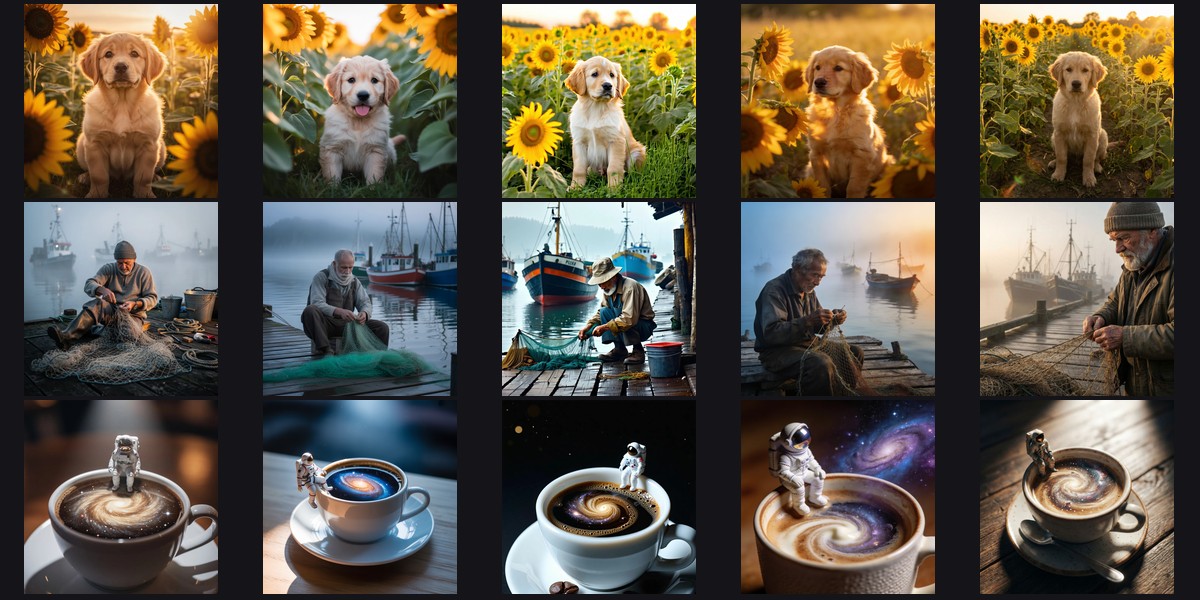
Prompt: A golden retriever puppy sitting in a field of sunflowers, golden hour lighting, photorealistic
We start with something elementary. No tricks — just a puppy in sunflowers. Seems simple, right?
What We Expect to See
A realistic photo of a golden retriever puppy among sunflowers, warm golden hour light. A simple task, understandable to any generator.
What to Look For
- Photorealism: does it look like a photo or a render
- Lighting: is it truly golden hour or just "bright"
- Fur and eye details: the main realism check
- Sunflowers: correct shape and scale relative to the puppy
Results
FLUX 2 Max created a warm, atmospheric scene with excellent lighting. The puppy's fur is detailed, sunflowers look natural. Background bokeh adds depth. Possibly the most "atmospheric" result in this test.
Ideogram v3 delivered a very clean, photorealistic image. The puppy looks like it's from a professional photoshoot. Textures are top-notch, but lighting is slightly less pronounced — more "bright day" than golden hour.
Stable Diffusion 3.5 did well, but the result is more "stock photo" style. Everything's correct, everything's in place, but no special "wow factor." A reliable, predictable result.
Seedream 4.5 created a bright, saturated picture with an interesting color palette. Perhaps slightly oversaturated colors, but the overall impression is pleasant. Good composition.
Nano Banana Pro showed a quality result with good balance of light and shadow. Slightly "softer" rendering compared to Ideogram, but overall quality is high.
Test #2: Medium Complexity
Prompt: A weathered fisherman in his 60s mending a net on a wooden dock, early morning fog, fishing boats in the background, cinematic lighting, shallow depth of field
Now it gets more interesting. A person with specific age and occupation, atmosphere, fog, depth of field. Room for errors — and for differences between generators.
What to Look For
- Face and hands: classic AI weak point. Wrinkles, fingers, facial expression
- Fog: natural or "painted"
- Net: small repeating structures — a nightmare for generators
- Depth of field: is the background properly blurred
- Overall "cinematicness": does it feel like a movie frame
Results
FLUX 2 Max created a very cinematic frame. The fisherman's face is well-rendered, wrinkles look natural, hands raise no questions. Fog looks authentic, depth of field is correct. The net is simplified in places, but the overall picture is impressive.
Ideogram v3 delivered excellent texture quality — wooden dock, clothing, skin. Realistic face, age reads well. Good fog, but less detailed net. Overall a very quality result.
Stable Diffusion 3.5 did okay, but the face is less expressive. Fog is there but a bit more "even" than desired. Simplified net. A reliable result without special revelations.
Seedream 4.5 created an interesting color atmosphere of morning fog. Good composition, but facial details are slightly less sharp. The net became almost an abstract texture rather than a clear object.
Nano Banana Pro showed a good overall result. Face is rendered decently, fog looks atmospheric. Hands and net are the weak spot, but the picture looks cohesive overall.
Test #3: Complex Prompt
Prompt: A tiny astronaut sitting on the edge of a coffee cup, looking up at a galaxy swirling inside the cup like cream in coffee, miniature tilt-shift photography style, dramatic lighting from above, hyperdetailed, 4K
Now the fun begins. Scale discrepancies (tiny astronaut on a regular cup), physically impossible things (galaxy in coffee), specific photography style (tilt-shift). This prompt tests whether the generator understands the concept, not just glues together tags.
What to Look For
- Scale: is the astronaut truly tiny or just normal-sized next to a giant cup?
- Tilt-shift: is there characteristic edge blur creating the miniature effect?
- Galaxy in coffee: did it manage to merge two concepts or is it a mess?
- Lighting: dramatic overhead light or just "bright from above"?
- Overall coherence: does it look like one photograph or a collage?
Results
FLUX 2 Max delivered the most interesting interpretation. Concept read correctly: tiny astronaut, galaxy in cup, tilt-shift effect present. Dramatic lighting, thoughtful composition. Possibly the best result in this test.
Ideogram v3 created a beautiful picture but deviated slightly from the prompt. The astronaut isn't that tiny, the galaxy is more painted than integrated into the coffee. Weak tilt-shift. Beautiful, but not quite what was requested.
Stable Diffusion 3.5 did okay. Concept understood, but execution simplified. Galaxy is there, astronaut is there, but the overall picture is less impressive. No "wow effect."
Seedream 4.5 created a bright, fantastical scene with interesting colors. The galaxy looks beautiful, but the tilt-shift effect is practically absent. More concept art than photography.
Nano Banana Pro delivered a solid result with all elements from the prompt. Attempted tilt-shift, galaxy in cup is present. Not the most wow-inducing picture, but honestly completed the assignment.
General Observations
After running three tests, patterns become visible. Here's what's important to understand:
Each Generator Has a "Character"
This isn't just a quality difference — it's a difference in approach. FLUX is a master of atmosphere and cinematography. Ideogram is a specialist in photorealism and textures. Stable Diffusion 3.5 is a reliable workhorse. Seedream is an artist with an interesting color vision. Nano Banana is a generalist with a focus on technical accuracy.
There Is No "Best" Generator
Seriously. If you need atmospheric illustration — use FLUX. Need a photorealistic product shot — Ideogram or Seedream. Need predictability and stability — Stable Diffusion 3.5. Need a mockup with text — Nano Banana Pro.
Same Prompt ≠ Same Result
This is the key takeaway. Prompts optimized for one model may not work on another. FLUX understands cinematographic terms well. Ideogram responds excellently to texture descriptions. Seedream loves color characteristics. If you're transferring a prompt from one platform to another — be ready to adapt it.
Cheat Sheet: Who For What
| Task | Best Choice | Why |
|---|---|---|
| Atmospheric art, cinematography | FLUX 2 Max | Best understanding of lighting and mood |
| Photorealism, portraits | Ideogram v3 Turbo | Excellent skin and material textures |
| Stable, predictable results | Stable Diffusion 3.5 | Reliable baseline model |
| Vibrant colors, interesting composition | Seedream 4.5 | Artistic color vision |
| Posters and mockups with text | Nano Banana Pro | Best text rendering |
| High resolution, speed | Seedream 4.5 | Up to 4K, fast generation |
Practical Tips
If you're just starting with AI image generation, here are some things that will save you time and money:
Try via Replicate. It's a platform with API access to all these models. You only pay per generation (usually $0.03–0.05 per image), no subscriptions. Perfect for experiments and small projects.
Don't copy prompts blindly. A prompt that gave amazing results in FLUX might produce complete nonsense in Stable Diffusion. Each model "hears" differently.
Use our guides. Understanding poses, emotions, angles, and lighting is a universal skill that works on any model. When you know how to describe the right pose or facial expression, it doesn't matter which model you use — the result will be better.
Experiment. The best way to understand a model is to just feed it different prompts and see what happens. No article (including this one) can replace your own experience.
Want more control over poses and facial expressions in AI generation? Check out our guides — 500 Poses and 132 Emotions — with ready-made prompts and reference photos for any generator.
Ready to Create Better AI Content?
Get professional prompt guides with reference photos — stop guessing, start creating.
Browse Guides →