One Prompt — 5 New Generators: Round 2 of AI Comparison
One Prompt — 5 New Generators: Round 2 of AI Comparison
We tested 5 more AI models with the same prompts. Can newcomers compete with the leaders? Surprising results inside.
Round 2: New Contenders
After our first comparison where we tested FLUX, Ideogram, Stable Diffusion, Seedream, and Nano Banana, we received a ton of questions: "What about Imagen 4?", "Have you tried Recraft?", "What's up with the new Chinese models?"
Fair enough. The AI generation world moves fast. Today's top models might be yesterday's news tomorrow. So we grabbed 5 more generators — some brand new, some underrated — and threw the same three prompts at them.
Same rules: no tweaking, no optimization, pure honesty. One text — five results. Let's see what happens.
Meet the New Lineup
Before diving into results, let's quickly introduce today's participants.
Z-Image Turbo (Pruna AI)
An optimized model from Pruna AI focused on speed without quality loss. "Turbo" isn't just marketing — this model genuinely generates fast while maintaining competitive quality. Built on efficiency-first architecture, it's designed for high-volume workflows where speed matters. Available via Replicate with budget-friendly pricing.
Qwen-Image (Alibaba)
From Alibaba's Qwen (Tongyi Qianwen) family comes this vision-language model. Part of China's push into AI generation, Qwen-Image brings strong technical capabilities especially with Asian aesthetics and cultural references. Interesting approach to prompt understanding with multilingual support baked in.
Recraft V3 (Recraft AI)
Recraft's third iteration focuses on design and illustration work. Unlike photorealistic-heavy models, Recraft V3 excels at vector-style graphics, logo design, and stylized illustrations. Version 3 added better photorealism support while keeping its illustrative strengths. A specialist trying to be a generalist.
Imagen 4 (Google)
Google's latest entry in the image generation race. Imagen 4 brings DeepMind's research into production, with emphasis on safety, accuracy, and prompt adherence. Strong backing from Google's infrastructure and research means consistent quality and regular updates. The corporate giant's answer to open-source models.
FLUX Schnell (Black Forest Labs)
From the creators of the original FLUX comes Schnell (German for "fast"). A streamlined version of FLUX optimized for speed — fewer diffusion steps, faster inference, lower compute cost. Trades some quality for speed, but still maintains the FLUX DNA. Perfect for iterations and previews.
Test #1: Simple Prompt
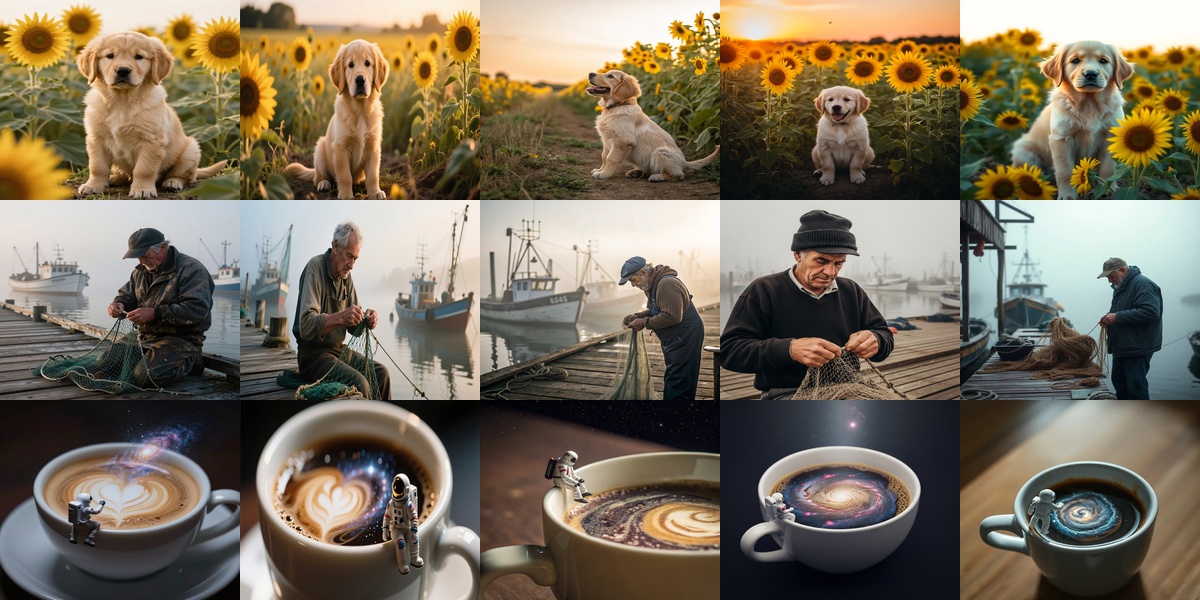
Prompt: A golden retriever puppy sitting in a field of sunflowers, golden hour lighting, photorealistic
Starting with the same simple prompt from Round 1. A puppy in sunflowers. Should be easy, right?
What We Expect
A realistic photo of a golden retriever puppy among sunflowers, warm golden hour light. Simple, clear, no tricks.
What to Look For
- Photorealism: actual photo quality or obviously rendered
- Lighting: true golden hour or just "bright"
- Fur texture: the devil's in the details
- Sunflower accuracy: correct scale and structure
Results
Z-Image Turbo delivered surprisingly clean results. Good photorealism, decent lighting. The fur texture is slightly softer than top-tier models, but for a speed-focused model, impressive quality. Sunflowers look natural. Solid baseline performance.
Qwen-Image created a very polished image with excellent composition. Interesting color balance — slightly cooler than traditional golden hour but aesthetically pleasing. Detail work is strong. The model clearly "understands" the scene well.
Recraft V3 struggled a bit here. The result leans slightly illustrative rather than photorealistic — you can see its design DNA coming through. Still pleasant to look at, but not hitting the "photorealistic" target as strongly as competitors. Sunflowers are well-rendered though.
Imagen 4 produced a very Google-style result: clean, safe, technically correct. Excellent lighting, good fur texture, everything in its place. Perhaps lacks some "character" compared to others, but you can't fault the technical execution. This is what "corporate AI" looks like — reliable and polished.
FLUX Schnell showed why the FLUX family is respected. Even the "fast" version maintains strong quality. Great atmospheric lighting, good depth of field, natural-looking puppy. The speed optimization doesn't seem to sacrifice much. Impressive balance.
Test #2: Medium Complexity
Prompt: A weathered fisherman in his 60s mending a net on a wooden dock, early morning fog, fishing boats in the background, cinematic lighting, shallow depth of field
Now we add complexity. A specific person, atmosphere, environmental storytelling. This is where models start showing their personality.
What to Look For
- Face and hands: age accuracy, wrinkles, fingers
- Fog atmosphere: natural or artificial
- Net texture: repeating patterns are hard for AI
- Depth of field: proper background blur
- Cinematic feel: does it look like a movie still
Results
Z-Image Turbo handled this reasonably well. Face looks aged appropriately, hands are acceptable (a weak spot for many models). Fog is present but slightly uniform. Net is simplified but readable. Overall a competent result that won't win awards but gets the job done.
Qwen-Image impressed here. Excellent facial detail with natural-looking wrinkles and weathered skin. Good atmospheric fog, nice color grading. The net is handled better than most competitors. Depth of field works well. Strong cinematic vibe. This model seems to excel at human subjects.
Recraft V3 again shows its illustration roots. The result is more concept-art than photograph. Beautiful in its own way, but straying from "cinematic photography" toward "painted illustration." If you wanted a storyboard or concept piece, perfect. For photorealism, not quite there.
Imagen 4 delivered solid technical execution. Good facial aging, proper fog, acceptable depth of field. The scene feels somewhat "staged" — very clean, very controlled. Less gritty realism, more "TV commercial" aesthetic. Quality is high, character is moderate.
FLUX Schnell created an atmospheric, moody scene. Great lighting work, good facial detail, fog feels natural. The net is simplified but the overall composition is strong. This model consistently punches above its "fast" categorization.
Test #3: Complex Prompt
Prompt: A tiny astronaut sitting on the edge of a coffee cup, looking up at a galaxy swirling inside the cup like cream in coffee, miniature tilt-shift photography style, dramatic lighting from above, hyperdetailed, 4K
The hardest test. Scale games, impossible physics, specific photography style. This separates concept-understanding from keyword-matching.
What to Look For
- Scale: is the astronaut truly miniature or just small
- Tilt-shift effect: characteristic edge blur
- Galaxy in coffee: did it merge the concepts or create chaos
- Lighting: dramatic overhead or just "bright from top"
- Overall coherence: single photo or obvious composite
Results
Z-Image Turbo gave it an honest try. Astronaut is there, cup is there, some swirl in the coffee. But the concepts don't fully merge — feels more like separate elements placed together. Tilt-shift is minimal. For a speed model tackling a complex prompt, respectable attempt but not wow-inducing.
Qwen-Image created something interesting. Good scale work with the tiny astronaut, nice galaxy effect in the coffee. Lighting is dramatic. However, tilt-shift is subtle to absent. The model clearly understood the concept and executed well on most elements. Strong interpretation if not perfect execution.
Recraft V3 went full artistic interpretation. Created a beautiful, stylized scene that's more "concept art" than "tilt-shift photography." Galaxy looks amazing, astronaut is well-rendered, but it's clearly illustration not photography. If you wanted art, you got it. If you wanted photorealism, this isn't it.
Imagen 4 tackled this methodically. All elements are present: tiny astronaut, galaxy coffee, overhead lighting. Execution is clean and safe. The result is technically correct but lacks some "magic" — it feels constructed rather than captured. Google's safety-first approach shows here.
FLUX Schnell surprised us. Managed to capture the concept well with good scale work, nice galaxy integration, and attempted tilt-shift effect. The lighting is dramatic, composition is thoughtful. For a "fast" model, it's punching way above its weight class on complex prompts.
General Observations: Round 2
After testing these five models, some patterns emerge clearly.
Speed vs Quality Isn't Always a Trade-off
Both Z-Image Turbo and FLUX Schnell are optimized for speed, yet both deliver quality that competes with slower models. The "fast" category has matured significantly. You don't always have to choose between speed and quality anymore.
Regional Differences in Aesthetic
Qwen-Image (Chinese) and Imagen 4 (American) show subtle but noticeable differences in color grading, composition preferences, and detail emphasis. Cultural background of training data and developer choices shape the output. Neither is "better" — just different.
Specialists Need Specific Use Cases
Recraft V3 keeps trying to be photorealistic when its heart is clearly in illustration and design. It's not a "bad" model — it's a specialist being asked to be a generalist. Use it for what it's good at (vector graphics, stylized illustrations) and it'll shine.
Corporate vs Open-Source Vibes
Imagen 4 (Google) has that polished, safe, corporate feel. Technically excellent but creatively conservative. Open-source adjacent models like FLUX Schnell take more creative risks. Both approaches are valid for different use cases.
Prompt Understanding Is Getting Better
All five models understood complex prompts better than models from even six months ago. The "tiny astronaut in coffee cup" concept that would have confused older models is now handled competently by most. The industry is maturing fast.
Comparison: Round 1 vs Round 2
How do our new contenders stack up against Round 1's lineup?
Best Photorealism:
- Round 1: Ideogram v3 Turbo
- Round 2: Qwen-Image
- Edge: Tie — both excel at different aspects
Best Atmosphere/Cinematography:
- Round 1: FLUX 2 Max
- Round 2: FLUX Schnell
- Edge: Round 1 (Max is still better than Schnell)
Best Speed/Quality Balance:
- Round 1: Seedream 4.5
- Round 2: FLUX Schnell
- Edge: Round 2 (Schnell is impressively fast)
Best for Complex Prompts:
- Round 1: FLUX 2 Max
- Round 2: Qwen-Image
- Edge: Round 1 (Max handles complexity better)
Most Reliable/Consistent:
- Round 1: Stable Diffusion 3.5
- Round 2: Imagen 4
- Edge: Round 1 (SD 3.5 is the boring reliable choice)
Cheat Sheet: Who For What
| Task | Best Choice from Round 2 | Why |
|---|---|---|
| High-volume workflow | Z-Image Turbo | Fast generation, decent quality, budget-friendly |
| Human portraits, faces | Qwen-Image | Excellent facial detail and skin texture |
| Design, illustration work | Recraft V3 | Built for stylized graphics, not photorealism |
| Safe, corporate content | Imagen 4 | Google-backed quality, safety-focused |
| Quick iterations, previews | FLUX Schnell | Fast like Turbo, quality like FLUX |
| Complex compositions | Qwen-Image | Strong prompt understanding |
Practical Tips: Rounds 1 & 2 Combined
If you've read both comparison articles, here's what you need to know:
For Maximum Quality: Use FLUX 2 Max (Round 1) or Ideogram v3 (Round 1) when quality is paramount and speed doesn't matter.
For Speed: FLUX Schnell (Round 2) or Z-Image Turbo (Round 2) when you need iterations fast or have budget constraints.
For Portraits: Qwen-Image (Round 2) or Ideogram v3 (Round 1) both excel at human faces and skin texture.
For Reliability: Stable Diffusion 3.5 (Round 1) or Imagen 4 (Round 2) when you need predictable, consistent results.
For Experimentation: Try everything via Replicate. At $0.02-0.05 per image, testing different models costs less than a coffee.
Master the Fundamentals: Understanding poses, emotions, lighting, and composition matters more than which model you use. A good prompt on a "worse" model beats a bad prompt on the "best" model. Check our guides for 500 Poses and 132 Emotions to level up your prompting skills.
The Bottom Line
Round 2 shows the AI generation landscape is healthy and competitive. No single model dominates everything. Speed-optimized models are getting good enough to challenge quality-focused ones. Regional players (Qwen from China) are bringing different perspectives.
The best model is the one that fits your specific use case, budget, and workflow. Don't follow hype — test for yourself. At Replicate prices, there's no excuse not to experiment.
And remember: all these models will be outdated in six months. The technology moves that fast. Stay curious, keep testing, and don't get too attached to any single platform.
Want to create better AI images regardless of which model you use? Master the fundamentals with our 500 Poses Guide and 132 Emotions Guide — universal skills that work on any generator.
Ready to Create Better AI Content?
Get professional prompt guides with reference photos — stop guessing, start creating.
Browse Guides →